
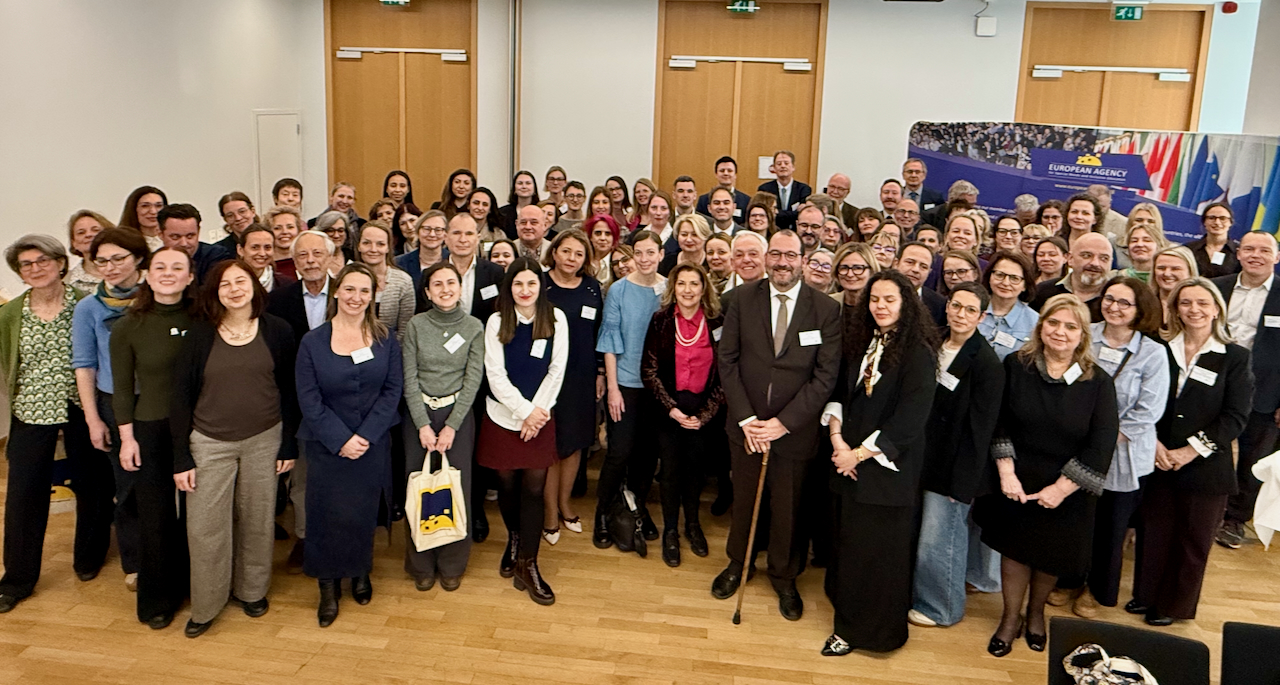
This one-day event in Brussels brought together national and European-level stakeholders for keynote speeches and panel discussions on the future of inclusive education. The event provided networking opportunities to foster dialogue between national representatives and Brussels-based education officers.
Date and location
19 March 2026, Brussels (by invitation only)
Programme
The programme included a welcome from EASNIE Chair Don Mahon and Thomas Eckert, Director of the Representation of the State of Hessen in Brussels. Roxana M?nzatu, Executive Vice-President of the European Commission, provided opening remarks.
EASNIE Director Jo?o Costa presented EASNIE’s anniversary video and its Ten Pillars Shaping the Future of Inclusive Education, a new common reference framework for countries and all stakeholders in inclusive education, from policy-makers to practitioners and learners.
A high-level panel discussion entitled ‘Shaping the Future of Inclusive Education’ brought together European and national leaders to reflect on progress to date and explore how inclusive education policies can be strengthened for the future.
Two discussion sessions also took place:
- ‘From Commitment to Implementation: Advancing Inclusive Education in Practice’ explored evidence, policies and practices that have proven effective in advancing inclusive education, highlighting why and how they work in different contexts.
- ‘Inclusive Education: Building a Societal Consensus’ examined how inclusive education can be supported through shared societal commitment, bringing together perspectives from policy-makers, practitioners and young people.
Finally, there was a poster session entitled 'Countries’ pathways towards inclusive education – inspiring policies and practices', which gave EASNIE member countries the opportunity to showcase an inspiring policy or practice aligned with EASNIE’s principles and collaborative work. View or download the posters.
Download the full event programme. Read more about the event in the news item.
Find out more about the panellists below.
Panellists’ biographies
High-level panel on Shaping the Future of Inclusive Education
-
Pia Ahrenkilde Hansen, Director-General, Directorate-General for Education, Culture, Youth and Sport (DG EAC), European Commission
Pia Ahrenkilde Hansen is the Director-General of the Directorate-General for Education, Culture, Youth and Sport at the European Commission. She took up this position in September 2023. Prior to that she was the Director-General in the Directorate-General for Communication, and has served as Deputy Secretary General and Chief Operating Officer. Between 2009 and 2014 she was Chief Spokeswoman of the European Commission, and Deputy Spokeswoman of the European Commission from 2004 until 2009 under former Commission President Barroso.
She began her career in political communication as Environment Spokeswoman in 1999 (Commissioner Margot Wallstr?m), having previously held positions in the Commission’s departments for Industry (1995–1997) and Information, Communication and Culture (1997–1999). She was a Schuman Scholar at the European Parliament (1989–1990). She studied Business Administration and Modern Languages at the Copenhagen Business School and Political Science at the Institut d’études Politiques de Paris.
-
Li Andersson, Member of the European Parliament, Chair of the Committee on Employment and Social Affairs (EMPL)
Li Andersson is a Member of the European Parliament and Chair of the Committee on Employment and Social Affairs. In Finland, she served as leader of the Left Alliance, Member of Parliament and Minister of Education in the Sanna Marin government between 2019 and 2023.
Her political work combines a strong stance on fundamental and human rights, and an ambitious environmental and climate policy, with policies such as strengthening workers’ rights and reducing economic and social inequalities.
-
Izabela Zi?tka, Undersecretary of State, Ministry of National Education, Poland
Izabela Zi?tka is Undersecretary of State at the Ministry of National Education, Poland. She is a teacher, educator, clinical neurologopedist and director of educational institutions in Poland and Germany.
A graduate of pedagogy and psychology, she holds bachelor’s degrees in Polish language studies and special education. She has also completed postgraduate studies in oligophrenopedagogy, speech therapy, clinical neurologopedics and early clinical speech therapy, education management, working with individuals with autism and Asperger’s syndrome, and neuropsychology.
Panel 1 – From Commitment to Implementation: Advancing Inclusive Education in Practice
-
Lucie Cerna, Senior Analyst in Equity, Inclusion and Transitions, Directorate for Education and Skills, OECD
Lucie Cerna is Senior Analyst and Project Leader in the Directorate for Education and Skills, OECD, Paris, and an Associate Research Fellow at the Centre for Liberal Arts and Social Sciences at Nanyang Technological University, Singapore. At the OECD, she has worked on a variety of education topics, including education governance, trust and national skills strategies, and is currently leading the Education for Inclusive Societies project.
Prior to joining the OECD, she was a Lecturer in Politics at Merton College, University of Oxford, and an Assistant Professor in Global Challenges (Political Economy) at Leiden University, Netherlands. Lucie has published widely on migration, education and skills issues. She holds a DPhil from the University of Oxford.
-
Krzysztof?Stefan?Iszkowski, Team Leader, European Child Guarantee, Directorate-General for Employment, Social Affairs and Inclusion, European Commission
Krzysztof Stefan Iszkowski is an economist and sociologist (PhD) currently serving as the Team Leader for the European Child Guarantee at the European Commission’s Directorate-General for Employment, Social Affairs and Inclusion (DG EMPL). He holds a PhD in Sociology/Economics with research interests in post-1989 social changes in Poland, European integration, and globalisation.
At DG EMPL, he has previously worked as a Policy Officer focusing on the labour and social dimensions of the European Semester. He has authored books on European and Polish identity.
-
Justine Sass, Chief of the Section of Education for Inclusion and Gender Equality, UNESCO
Justine Sass has over 25 years of development experience in the areas of education, health, gender equality and social justice at global, regional and national levels.
She is currently the Chief of the Section of Education for Inclusion and Gender Equality at UNESCO Headquarters in Paris, France, where she leads UNESCO’s global initiatives to support gender-transformative and inclusive education with a lifelong learning perspective. This includes providing strategic directions and supporting knowledge generation, technical assistance and global co-operation, with a strong emphasis on equity and inclusion.
Before joining UNESCO, Justine worked for other international organisations, NGOs and government agencies across Asia and the Pacific, Sub-Saharan and North Africa and Eastern Europe. She believes that we all have a role to play in ensuring an inclusive and equitable society that leaves no one behind.
Panel 2 – Inclusive Education: Building a Societal Consensus
-
David Rodrigues, Professor of Inclusive Education, Portugal
Having graduated with a Special Education teaching doctorate in 1987, David Rodrigues has taught at the University of Lisbon, as well as various other universities in Portugal (Porto, the Azores and Coimbra) and abroad (KU Leuven – Belgium, VS University – USA and UNICAMP – Brazil). He has worked on international projects for UNICEF, UNESCO and Handicap International.
He has published 30 books and dozens of articles in specialised journals. In 2007, he was awarded the Latin Union Research Prize and, in 2021, with the International Leadership Award, awarded by the Council of Exceptional Children – DISES (USA). In 2023, he received the Gold Medal of Human Rights, awarded by the Portuguese Parliament. David Rodrigues is a guest lecturer in several foreign universities. He was founder and President of Pro-Inclusion / National Association of Special Education Teachers and is currently director of the magazine Inclusive Education. Since 2015, he has been a National Counsellor of Education.
-
Lilia Touil, French jurist, youth advocate and founder of OUI Legacy
Lilia Touil is a French jurist specialised in international, European and digital law, with a focus on intellectual property and new technologies. Committed to advancing education and the Sustainable Development Goals, she engages as a youth advocate with the ONE Campaign, the Global Partnership for Education, TheirWorld and Plan International. This engagement has led her to contribute to and speak within European, French and multilateral institutions, including UNESCO and the United Nations General Assembly. Building on this trajectory, she is currently developing a research project that connects international and European legal frameworks with contemporary education and global development challenges. She is also the founder and president of Oui Legacy, a conversational initiative dedicated to heritage, memory and civic belonging.
-
Brikena Xhomaqi, Director of the Lifelong Learning Platform
Brikena Xhomaqi has been the Director of the Lifelong Learning Platform – European Civil Society for Education since 2016. The Platform represents over 40 European-wide civil society networks in the field of education from early childhood to adult education, including formal, non-formal and informal learning providers and learners.
She served as co-chair of the European Economic and Social Committee Liaison Group of Civil Society (2020–2025) and as a member of the Civil Society Europe Steering Committee (2017–2019). She is the former Head of Office of the European Students’ Union (ESU) and Director of the Erasmus Student Network (ESN). She was active in civil society from an early age as an elected representative of different school and university student bodies.